THE BUYING DECISION IN 30 SECONDS
The costly mistake isn't buying an expensive welder. It's buying DC-only TIG when your shop needs AC TIG.
As an Amazon Associate I earn from qualifying purchases. Links on this page are affiliate links, at no extra cost to you. How affiliate links work here.
Aluminum TIG + steel MIG | Shop purchase checkpoint
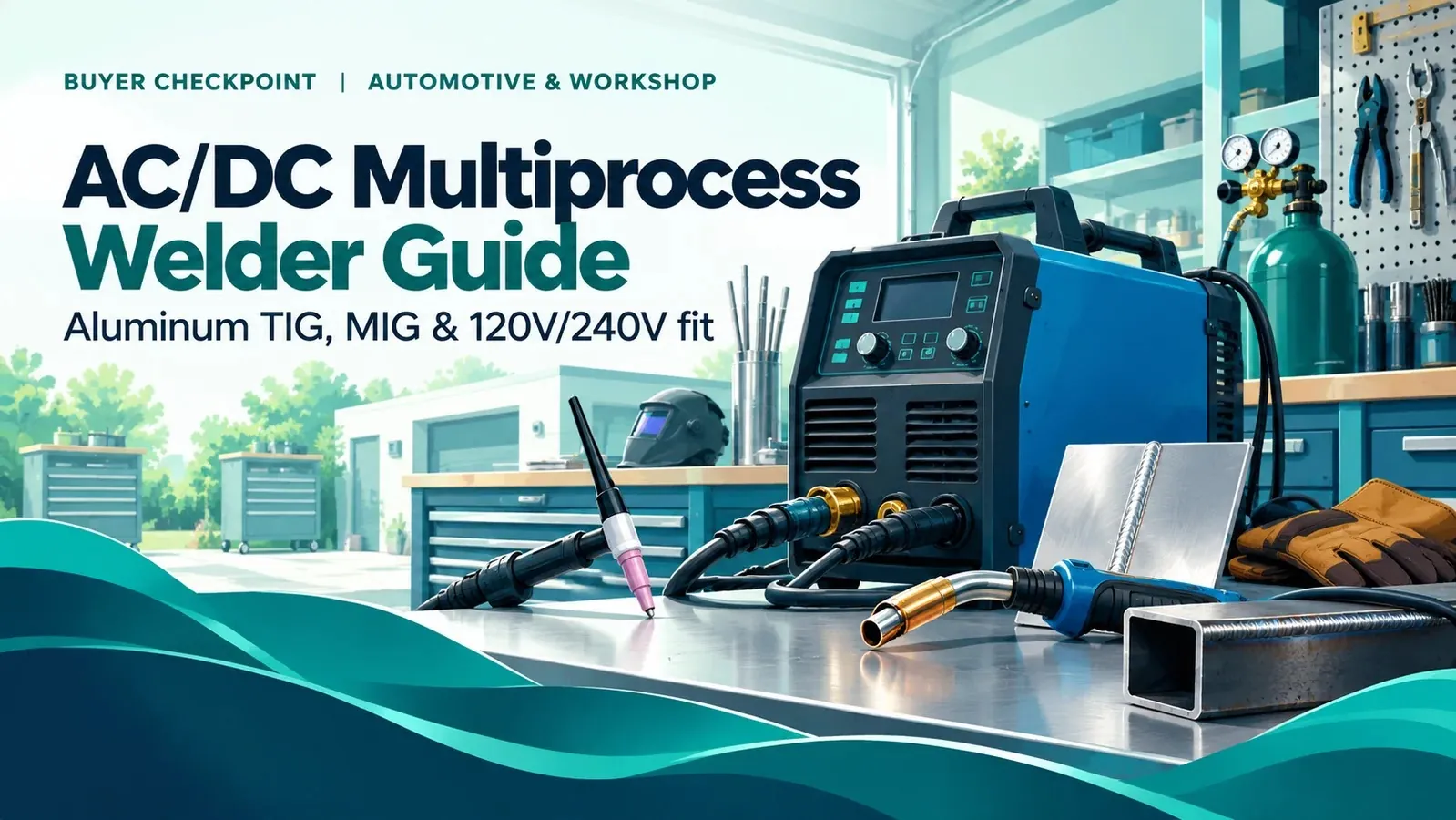
A machine can say MIG + TIG + Stick and still fail the one job that made you shop for it: precise aluminum TIG. Before buying a multiprocess welder, check the two letters almost every product description buries—AC. The Miller Multimatic 220 AC/DC (stock 907757, ASIN B07K3CTMJ2) documents AC/DC TIG. The Multimatic 215 does not. At 240V the published MIG rating is 200A at a 20% duty cycle.
Affiliate reminder: Cart and product links below are Amazon affiliate links. Full disclosure.
Buyer Checkpoint editorial score
Miller Multimatic 220 AC/DC (907757)
Recommended for the right shop — conditionalWho this score is for: a small fabrication or restoration shop that regularly needs aluminum AC TIG and steel MIG in one machine, has an appropriate 240V supply, and does not require sustained high-current production duty. 95/100 is a scenario-specific technical fit score—not a universal rating.
Strong conditional match for a shop that regularly alternates aluminum AC TIG and steel MIG on a suitable 240V circuit within the published duty cycle.
Miller documents AC/DC TIG, MIG, flux-cored and stick, dual-voltage input and process-specific duty cycles—not continuous-output promises.
The documented 907757 package lists a TIG torch and foot control. Gas setup is required; aluminum MIG needs a separately purchased compatible spool gun.
Gas cylinders, consumables, electrical readiness and optional aluminum-MIG gear dominate ownership cost beyond the machine itself; we score setup burden, not a sticker price.
Identified stock 907757 / ASIN B07K3CTMJ2 and manufacturer specifications support the claims. No hands-on endurance testing is claimed.
Scoring basis: Buyer Checkpoint’s public default framework 30 / 25 / 20 / 15 / 10 (use-case & safety fit, documented capability, integration & completeness, total ownership considerations, strength of supporting evidence), as published on How we research and score, applied here on November 5, 2026. 95/100 is a scenario-specific editorial fit score—not an Amazon customer rating, laboratory result or safety certification. If circuit, workflow, model identity or duty cycle fails, do not buy regardless of the score.
Buy if: your shop regularly needs aluminum AC TIG alongside steel MIG, you have (or will install) a suitable 240V circuit, and the published 20% duty cycle at 200A MIG covers your actual work. The Miller Multimatic 220 AC/DC (907757) is then a credible one-machine solution.
Don’t buy if: you only need steel MIG, your aluminum work is occasional spool-gun MIG, you only have 120V and need full rated output, or you require sustained high-amperage production duty. AC TIG is the feature that justifies the price—and only if you will use it.
1. Pick the welding process before the product
First decide what “aluminum welding” actually means
Two jobs that sound identical in a product listing can require different processes, accessories and budgets.
Precision aluminum TIG
Look for AC TIG capability. The machine needs to support the welding process you will actually use.
- AC TIG-capable power source, compatible torch and foot control
- Suitable argon supply and work preparation
- Miller 220 AC/DC: yes. DC-TIG-only Multimatic 215: not the same process capability
Aluminum MIG
This is a wire-feeding and setup decision. AC TIG is not automatically required for aluminum MIG.
- Compatible spool gun or validated aluminum wire-feeding arrangement
- Correct wire and shielding gas for the application
- For the Miller 220: the aluminum MIG spool gun is a separate purchase
Buyer Checkpoint process selection guide. This is not a welding procedure, installation approval or substitute for manufacturer safety instructions. Process capability claims: Miller Multimatic 220 AC/DC model page and AD/9.0 spec sheet, Feb. 2026.
Will the Miller 220 fit your welding jobs, workload and electrical supply?
Choose the three answers that describe your shop. The result below updates immediately and explains whether this AC/DC multiprocess machine is worth shortlisting.
This tool does not collect or transmit responses. It does not estimate a safe circuit size, certify any weld, or replace the manufacturer's ratings and local electrical/safety requirements.
Buy one AC/DC machine when...
You regularly need steel MIG and aluminum TIG; floor space is scarce; you value rapid process changes; most jobs sit within light-industrial duty-cycle constraints; and 240V power is available.
Buy something else when...
You only weld steel, aluminum MIG is sufficient, you require production-grade high-duty-cycle output, you expect high-amperage welding from an ordinary 120V receptacle, or a dedicated specialized TIG system is essential.
2. The specification almost no general-purpose buying guide explains
“Multiprocess” describes how many welding processes a power source supports, not whether every process works equally well on every metal. For a shop buying its first serious machine, that distinction can consume thousands of dollars before the first bead is laid.
MIG welding mild steel is a wire-feed process with one set of equipment priorities: stable arc, wire drive, contact tips, shielding gas, joint access, and duty cycle. TIG welding aluminum is a different problem. Its persistent oxide layer has a higher melting temperature than the base aluminum, and conventional aluminum TIG work commonly uses alternating current for oxide-cleaning action while maintaining heat into the workpiece. A TIG-capable machine that only supplies DC is not interchangeable with an AC/DC TIG power source for that application.
This is why a 120/240V MIG + Stick + DC TIG machine can be excellent for steel and still be the wrong purchase for someone who repairs thin aluminum brackets, precision housings, intercooler piping, or aluminum fabrication projects using TIG. The lower-cost welder can sound like a “four-in-one” purchase while missing the one mode your business actually needs.
There is a second trap: aluminum MIG is not aluminum TIG. A spool gun is often the practical way to feed softer aluminum wire without buckling it through an ordinary long liner. You may be able to weld aluminum by MIG on a DC multiprocess welder, but that does not magically give it AC TIG functionality. Different finish, access, heat input, preparation, operator control, and job requirements can make the distinction commercially decisive.
Three actual shop scenarios
Auto restoration shop: most jobs are steel patches and brackets; aluminum panels or custom aluminum accessories appear several times per month. A multiprocess machine with AC TIG might make sense because switching processes quickly avoids a second full workstation. The value lies in the work mix, not the badge on the machine.
Mobile repair contractor: travels with uncertain electrical supply, does stick repairs outdoors, sometimes MIG, rarely precision aluminum TIG. A robust DC-only multiprocess unit or separate stick machine may be more rational; a 56-pound premium AC/DC rig buys capability that may never be used.
High-volume production fab shop: repeatedly runs long beads at high current, with multiple operators or thick materials. The important number is not peak amperage but the actual rated duty cycle, cooling capacity, uptime, service coverage and whether separate dedicated processes would avoid downtime.
3. Miller Multimatic 220 AC/DC: what the specifications actually buy
The actual recommendation is Miller stock number 907757, a 120/240V single-phase unit supporting MIG (GMAW), flux-cored (FCAW), DC stick (SMAW), AC/DC TIG and pulsed DC TIG. The exact Amazon US model we investigated is ASIN B07K3CTMJ2; the linked product name and model number must match before purchase.
Its valuable convenience is less flashy than the headline amperage. Miller's QuickTech system can recognize a process change when the MIG trigger or TIG foot control is used, automatically select the relevant process and recall the last settings. A shop moving repeatedly between steel MIG and aluminum TIG can avoid unplugging and reconfiguring the unit every time. Miller also documents two gas connections so MIG mix and TIG argon lines can remain installed.
For TIG, Miller publishes adjustable AC balance (60–80%), AC frequency (60–150 Hz), pulsed DC TIG settings up to 150 pulses per second, and high-frequency starts. Those are operationally meaningful controls: AC balance influences cleaning versus penetration, while AC frequency influences arc focus. These published ranges also establish a limit. If a specialist TIG workflow demands a wider AC frequency or balance range, the 220 may not be the best tool even though it is an AC TIG machine.
For thickness claims, the manufacturer lists MIG on mild steel from 24 gauge up to 3/8 inch, TIG on aluminum from 24 gauge to 1/4 inch, and aluminum MIG from 18 gauge to 3/8 inch. Those are stated capability ranges under suitable conditions, not a substitute for a qualified welding procedure, material preparation, joint design, or production proof test.
| Verified feature | Miller Multimatic 220 AC/DC | What it means for you |
|---|---|---|
| Aluminum TIG | AC TIG available | Passes the key AC/DC capability checkpoint |
| Steel TIG | DC TIG, HF start | Separate DC process with high-frequency arc-start option |
| Steel/aluminum MIG | MIG, up to 230A range | Spool gun is extra for aluminum MIG |
| Stick/field work | DC stick, E6010 capable | Useful secondary process; circuit and duty cycle still matter |
| Input supply | 120V or 240V single phase | Does not deliver the same maximum output on both |
| Gas workflow | Two gas connections | Reduced time switching processes, not free cylinders |
| Product package | TIG torch, MIG gun and pedal listed | Check the exact seller's SKU and included accessories |
4. Duty-cycle reality: 230 amps is not the number to buy on
Here is the single most important productivity calculation in the entire article. A welder's duty cycle is the share of a standardized ten-minute period it can weld at a specified rated output under the test conditions before needing cooling time. The advertised maximum output range does not say how long you can run at that current.
According to the Miller February 2026 specification sheet, the 220 offers the following representative rated performance:
Published operating points
Miller’s published rated points—not extrapolated output claims. Weld/cooling minutes below are simple conversions of each stated percentage over a standardized ten-minute cycle.
| Process & power | Rated output | Duty cycle | Illustrative weld time / 10 min |
|---|---|---|---|
| MIG, 120V | 105A at 19.2V | 60% | 6 minutes welding, 4 minutes cooling |
| MIG, 240V | 200A at 24V | 20% | 2 minutes welding, 8 minutes cooling |
| MIG, 240V | 170A at 21.5V | 40% | 4 minutes welding, 6 minutes cooling |
| TIG, 120V | 130A at 15.2V | 40% | 4 minutes welding, 6 minutes cooling |
| TIG, 240V | 210A at 18.4V | 20% | 2 minutes welding, 8 minutes cooling |
| Stick, 240V | 200A at 28.4V | 15% | 1.5 minutes welding, 8.5 minutes cooling |
Duty-cycle decoder — which Miller rating matches your work?
Choose a manufacturer-rated operating point. The calculation converts its stated duty cycle into welding and cooling minutes per standardized ten-minute interval. It does not predict the rating at any unlisted amperage.
For each rating: welding minutes = duty-cycle percentage / 10. Actual results depend on equipment condition, temperature, current settings and manufacturer's operating guidance. For operator planning, refer to the full duty-cycle curves, not this calculator alone.
Consider two very different workflows. A mobile mechanic who makes short repairs, prepares the next joint, positions clamps, and pauses between beads may never feel constrained by a 20% rating at high current. A fabrication shop paying a welder for repetitive long beads can hit that thermal ceiling quickly. The same machine can be good value in the first shop and a poor capital allocation in the second.
It is also incorrect to interpret the ten-minute chart as a guaranteed continuous work/rest schedule for every temperature and setting. The curves are rated test points. Welding procedure, ambient temperature, ventilation and operating conditions can influence practical operation. When the work is repetitive, verify the actual amperage at the required duty cycle before selecting the unit.
5. What's actually included—and the expensive accessory trap
A product page saying “complete multiprocess welder” sounds like an all-in-one business purchase. It is only complete for the processes and materials covered by the actual kit. Before ordering, compare the seller's package list against the manufacturer stock number.
Manufacturer lists in the 907757 package
- MDX-100 MIG gun
- Weldcraft A-150 TIG torch
- Wired RFCS-14 HD foot control
- Stick electrode holder and work clamp
- 120V/240V MVP plug adapters
- Two shielding-gas regulators and hoses
- Basic wire, contact tips and drive-roll accessories
Not automatically included
- Aluminum MIG spool gun
- Argon or MIG shielding-gas cylinder/fill
- Qualified electrical circuit or installation
- Helmet, gloves, protective clothing and fume controls
- Optional cart / cylinder rack
- Ongoing filler metal, contact tips and consumables
Two expensive misunderstandings appear here. First, the TIG torch is included in the manufacturer's documented 907757 package; this avoids the need to budget a separate basic TIG setup, although torch accessories and supplies still have costs. Second, if you want to run aluminum MIG, the commonly recommended Spoolmate spool gun is separate. Miller documents the Spoolmate 100 (part 300371) and 150 (301272), with different wire-family and rating specifications. Do not buy the cheapest available gun without confirming the exact aluminum wire you intend to use.
The published manufacturer list and an Amazon merchant's bundle are not automatically identical. Some sellers offer cart or pedal variations. If the Amazon listing title or package photograph contradicts the manufacturer stock number, request confirmation in writing. You are buying an exact configuration, not a stock photo.
Two gas regulators do not mean two full bottles
The 220's dual gas connections are an advantage for an alternating MIG/TIG workflow: one line can remain set up for MIG shielding gas, the other for argon TIG. They reduce connection changes and setup mistakes. They do not eliminate gas-cylinder rental, refills, leak checks, regulator compatibility or floor-space requirements for safe cylinder storage.
Likewise, a supplied foot control improves TIG ergonomics, but does not substitute for an appropriately sized workbench, welding table, clamps, joint-preparation equipment, fire precautions or qualified instruction.
6. Total cost of ownership: stop comparing only the machine sticker
For a machine with a US market price in the several-thousand-dollar range, the difference between a credible investment and a bad one often comes from what has to be purchased after delivery. Buyer Checkpoint therefore uses a configuration checklist rather than pretending an Amazon retail price is the finished shop cost.
| Cost bucket | Typical decision | Risk if ignored |
|---|---|---|
| Machine and freight | Exact stock 907757, new/used, seller, delivery | Wrong bundle, returns, warranty uncertainty |
| Electrical readiness | Confirm 240V branch circuit and code compliance | Paying for performance the site cannot use |
| Gas and cylinder handling | Argon TIG + appropriate MIG gas mix | No practical setup for both workflows |
| Aluminum MIG gear | Spoolmate compatible gun if required | Soft-wire feeding issues / extra cart and cable costs |
| Safety and ventilation | PPE, fire protection, fume control | Unacceptable work environment |
| Consumables and training | Tungsten, filler, tips, wire, prep, qualified procedure | Rework, scrap, downtime |
| Opportunity cost | Duty cycle, workload and process changeover | Machine is paid for but cannot support production demand |
A decision model that doesn't invent market prices
Use this ownership-cost checklist: complete first-year ownership cost = machine purchase + electrical work + gas setup + optional aluminum-MIG equipment + safety gear + consumables + anticipated maintenance + financing costs. If you already own some of these assets, exclude only those truly usable with this unit. Treat salvage value and saved labor as separate uncertain assumptions, not guaranteed rebates.
Imagine that the 220 saves repeated switching time between two dedicated machines. To value that benefit, estimate how often it happens, the number of productive minutes saved per changeover and your shop's fully loaded labor rate. If it saves five minutes on ten changeovers each week, that's 50 minutes weekly. Whether this is worth a premium depends on actual throughput and the price of a suitable alternative—not a general statement that “one machine is always cheaper.”
In the opposite direction, consider the downtime cost of a single machine serving every process. When that unit is away for service, all those capabilities may be unavailable simultaneously. A high-volume shop may prefer two dedicated machines as an operational resilience decision even when their combined initial purchase price is higher.
What about the manufacturer rebate?
Miller displayed a manufacturer rebate for select products through December 31, 2026 during this research. Do not assume a seller, marketplace purchase, SKU or checkout date is eligible merely because the manufacturer's site shows a promotional banner. Verify the offer terms, dealer eligibility, invoice documentation, postmark deadlines and whether the Amazon seller is an authorized distributor. We deliberately do not subtract that rebate from any price estimate in this guide.
7. Multimatic 220 AC/DC vs the 215: the difference that changes the decision
A common search begins with the less expensive Miller Multimatic 215, then drifts toward the 220. The right choice is not simply “newer and pricier.” The critical distinction is the type of TIG current.
| Buyer question | Multimatic 215 | Multimatic 220 AC/DC |
|---|---|---|
| Steel MIG, flux-cored, stick | Yes | Yes |
| DC TIG on suitable materials | Yes, accessories depend on configuration | Yes, TIG torch and foot control documented |
| AC TIG for aluminum | No — DC TIG only | Yes |
| 120/240V input | Yes | Yes |
| Aluminum MIG capability | With proper spool gun and setup | With proper spool gun and setup |
| Best fit | Steel-first general multiprocess work | Mixed MIG + precision aluminum TIG workflow |
If your shop's only aluminum work is occasional MIG using a spool gun, paying for the 220's AC TIG hardware may not produce any value. If you regularly need controlled TIG welds on aluminum, buying a DC-only 215 because it also says “TIG” is a predictable avoidable mistake.
Could you instead buy a dedicated aluminum AC/DC TIG machine plus a separate MIG unit? Absolutely. That may deliver a better combined duty-cycle and service profile. The 220 is strongest for shops valuing compactness, process versatility and quick changeovers more than high-volume parallel production.
8. Who should actually buy this Miller—and who should walk away?
Our conditional pick: Miller Multimatic 220 AC/DC, stock 907757
For a small professional shop, automotive fabricator, restoration business or advanced owner-operator that actually needs AC TIG aluminum work alongside steel MIG and stick, the Multimatic 220 is worth shortlisting. The published process breadth, 240V TIG/MIG output, included TIG kit, QuickTech switching and independent manufacturer documentation support that fit.
Buy only if: the exact stock number is confirmed, a trustworthy Amazon US seller has a new purchasable offer, the included torch/pedal/gas accessories are correct, your electrical supply is appropriate and the duty-cycle table is sufficient for the work you actually perform.
This button goes directly to the documented Miller 907757 product listing, not an Amazon search page. Marketplace price, availability, seller and eligible promotions may change. Confirm the new offer, warranty and package at checkout.
Do not choose it based on a feature checklist alone
Reject the machine for a dedicated production-line duty-cycle requirement that exceeds its published ratings; for an AC TIG process requiring controls outside its stated range; for a shop without the correct power supply; or if the available Amazon offers cannot establish the item, authorized support and warranty terms satisfactorily. Never treat a seller's words “industrial grade” as a substitute for a workload calculation.
If an online offer appears dramatically cheaper than the established US equipment market, verify whether the item is new, refurbished, missing the pedal or TIG torch, gray-market inventory, or an incompatible regional version. The risk is not only receiving a different box. It's losing project time because the configuration cannot do the contracted work.
9. Seven questions to answer before you pay
- What's the actual aluminum process? AC TIG, aluminum MIG, or both? Do not answer “aluminum welding” generically.
- What is the amperage at your actual duty cycle? Choose the manufacturer's rated point closest to the job's current and duration.
- Do you have appropriate 240V power? Confirm the supply, branch circuit, outlet and ground with a qualified electrician.
- Is the seller offering stock 907757? Confirm new condition and the complete list of included torch, control, regulators and plugs.
- Will you run aluminum MIG? Choose a manufacturer-compatible spool gun and the wire alloy; it is not in the basic 220 package.
- What are the recurring and setup costs? Gas, cylinder handling, wire, tungsten, torch consumables, helmet, ventilation, cart and service.
- What happens when the unit is down? Consider warranty availability, local repair access and whether a backup machine is necessary for your workload.
Need more context? Start with the Automotive & Workshop Equipment buying hub, read how we research and score, and compare process fit against our earlier checkpoint on 2-post car lift shop fit (same shop-constraint mindset: power, space, duty). Full affiliate disclosure applies to Amazon links.
10. FAQ: the costly questions buyers ask
Can the Multimatic 215 TIG weld aluminum?
It is a DC TIG machine, not an AC TIG machine. That makes it a poor substitute for a conventional AC TIG setup when controlled aluminum TIG is the requirement. It may support aluminum MIG with appropriate accessories, which is a different process. Verify the current model/specification with Miller if choosing a 215 variant.
Is the Miller 220 a true AC TIG welder or just “TIG ready”?
It is a documented AC/DC TIG machine. Miller lists AC balance 60–80%, AC frequency 60–150 Hz and high-frequency start. Unlike a DC-only TIG-capable multiprocess unit, it provides the relevant AC TIG mode.
Does the Miller 220 come with the TIG torch and foot pedal?
The manufacturer lists a 12.5-foot Weldcraft A-150 TIG torch and RFCS-14 HD wired foot control in the documented 907757 package. But verify the actual Amazon seller bundle and SKU before ordering.
Will it MIG weld aluminum out of the box?
Do not assume so. The standard package does not include the aluminum spool gun. Miller lists separate compatible Spoolmate accessories with different wire and duty-cycle specifications. You also need appropriate gas, wire, prep and safe practices.
Can I use it from a normal 120V outlet?
It supports 120V input with the correct supply, but output and duty-cycle performance differ from 240V. Miller publishes 105A MIG at 60% duty cycle on 120V versus 200A MIG at 20% on 240V. Confirm circuit ratings and connector requirements; do not improvise electrical adapters.
Does 230 amps mean I can weld nonstop at 230A?
No. Miller's 240V MIG rated example is 200A at 20% duty cycle, or 170A at 40%. Always look at the duty-cycle curve for the specific process, supply and output.
Is one multiprocess welder better than two dedicated machines?
Not always. One machine can cut process-changeover time and save workspace. Two dedicated machines may offer better simultaneous throughput and resilience when one is down. Compare the actual workload and lifecycle cost rather than the number of process labels.
Can it run from a 10,000-watt generator?
Miller says full output is available with appropriate generators providing 10kW or more. Confirm that the generator's continuous output and power characteristics fit the manufacturer requirements; smaller units may limit welding output.
Do the TIG and MIG gas cylinders come with the welder?
No. Miller includes two regulators and hoses but not shielding gas cylinders or filled gas. Budget cylinder acquisition/rental, refills and approved storage.
Is this machine for full-time industrial production?
Its documented positioning is light industrial, hobby and small shops. If you need very long high-amperage welds, production uptime and rated duty cycle may favor a higher-output dedicated machine. Assess the exact duty point and service model.
11. Sources and verification notes
We compared manufacturer product information, the February 2026 technical specification sheet and the exact Amazon US product identifier. The ratings and market offer evidence are checked separately from the engineering claims; no claim of hands-on shop testing is made.
- Miller Electric — Multimatic 220 AC/DC model 907757: processes, components, supported workflows.
- Miller Electric — Multimatic 220 AC/DC specification sheet AD/9.0, issued February 2026: duty cycle, input supply, accessories and control ranges.
- Miller Electric — Multimatic 215: DC TIG and other supported processes.
- Amazon.com — Miller 907757 / ASIN B07K3CTMJ2 (paid affiliate link); verify current listing terms before purchase.
Buyer Checkpoint · Review date: October 31, 2026 · We focus on documented purchase requirements and costly mismatches. We do not claim to have physically tested this unit. Manufacturer specifications may change; always use the current manual and qualified workplace safety practices for actual operation.
Amazon Associates disclosure
As an Amazon Associate I earn from qualifying purchases. Links to Amazon.com products and Add to Cart URLs on this page are affiliate links and may earn Buyer Checkpoint a commission at no extra cost to you. Buyer Checkpoint is a research guide, not the seller. Confirm the exact model (Miller stock 907757 / ASIN B07K3CTMJ2), seller, package contents, warranty and current price on Amazon before you buy. We do not invent prices, availability, ratings or commissions.
Miller Multimatic 220 · Adding to cart does not purchase or reserve the item
Add to cart