THE BUYING DECISION IN 30 SECONDS
A 50-amp connector does not create 50-amp shore power.
As an Amazon Associate I earn from qualifying purchases. Links on this page are affiliate links, at no extra cost to you. How affiliate links work here.
Scope: documentary buying guide. The original research, technical caveats and product limitations are preserved below; no hands-on testing is claimed.
Buyer Checkpoint editorial score
Anker SOLIX F3800
Conditional scenario-specific fitScore caveat: This is the original article’s scenario-specific editorial technical-fit score, not an Amazon customer rating, laboratory result, universal recommendation or safety certification. The original scoring framework and deductions are retained in the evidence below. If a hard constraint fails, do not buy regardless of the score.
Evidence, specifications and ownership limits
BUYER CHECKPOINT / RV ELECTRICAL / PORTABLE POWER STATIONS
Affiliate disclosure: As an Amazon Associate I earn from qualifying purchases. Some links on this page are affiliate links, at no extra cost to you. How affiliate links work here.
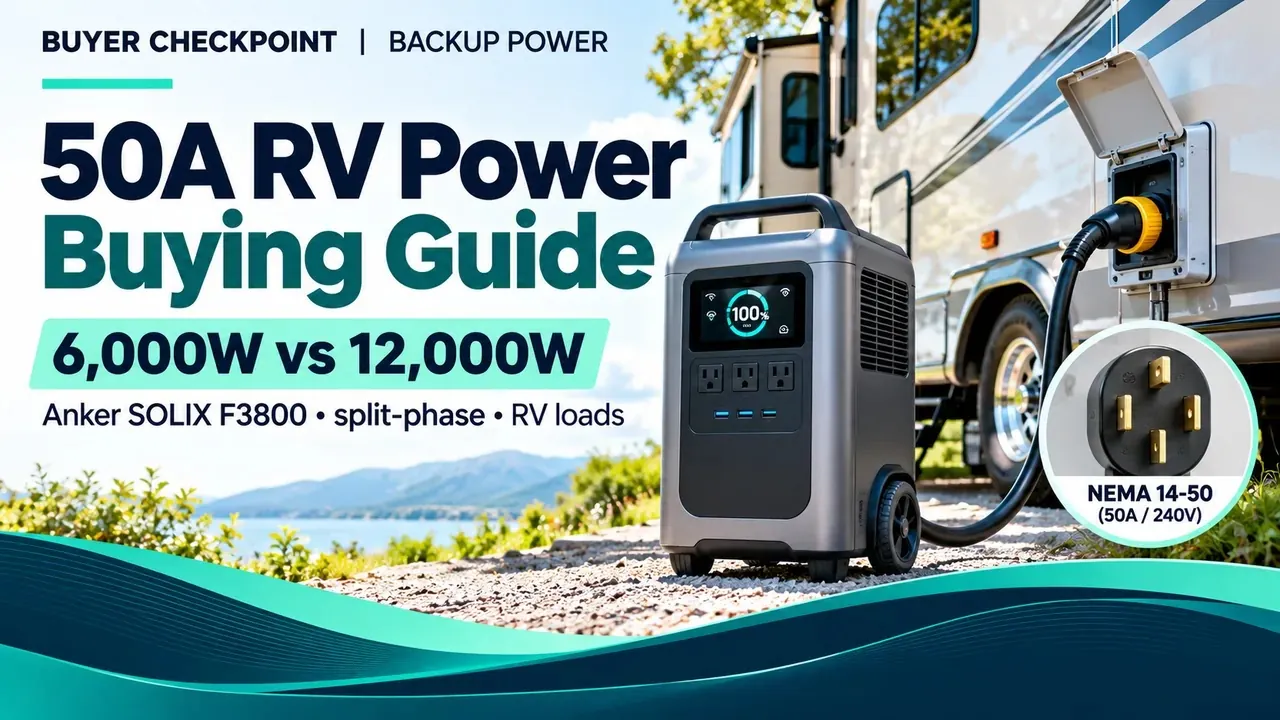
That 50-amp RV cord may fit your battery station. It does not mean you suddenly have 50-amp campground power. The Anker SOLIX F3800 (ASIN B0C5C9HMQ2) delivers up to 6,000W / 25A at 240V from its 14-50 outlet. A standard 50A shore pedestal can supply up to 12,000W. Plug compatibility is not power equivalence.
THE 25-SECOND ANSWER
The Anker SOLIX F3800 is a credible premium choice for selectively powering a 50-amp, 120/240V RV—not for replacing a full 50-amp shore pedestal. Its NEMA 14-50 outlet supplies up to 6,000 watts / 25 amps at 240V, while a conventional 50-amp RV shore connection can provide up to 12,000 watts. Plug compatibility is not power equivalence. Buy it when your measured essential RV loads and startup surges fit, and you want quiet, emission-free battery operation. Do not buy one F3800 expecting to run every air conditioner, water heater, cooker, dryer and charger simultaneously. See the limit table before ordering.
BUYER CHECKPOINT SCORE
Anker SOLIX F3800 — for a 50A RV running a deliberately limited, measured set of loads
This is not a universal 92/100: for a buyer requiring the full 12kW capability of a campground pedestal, one F3800 fails the hard-stop condition regardless of score. Methodology: How We Research and Score. Checked October 31, 2026.
Buy if: you need quiet, emission-free power for a deliberately limited set of RV loads (refrigerator, electronics, one air conditioner or less), your measured simultaneous draw stays under 6,000W, and you have a safe hookup plan. The Anker F3800 is then a credible premium choice.
Don’t buy if: you expect one F3800 to replace a full 50A campground pedestal (12,000W), you plan to run two air conditioners plus cooking and water heating at once, or you need multi-day runtime without recharging. The 6kW ceiling is a hard stop.
STRONGEST CONDITIONAL PICK FOR LIMITED RV LOADS
Anker SOLIX F3800 — 3,840Wh / 6,000W (ASIN B0C5C9HMQ2)
Once your essential loads and hookup are confirmed, this is the listing to check.
Confirm the original F3800 (not Plus), seller terms, and that your simultaneous RV loads stay under 6,000W.
Fit check
Three answers. The card on the right updates with the path that fits.
What is your peak simultaneous RV load?
Do you need multi-day runtime without recharging?
Do you have a safe, approved hookup plan?
The four-number check: 50A, 240V, 6,000W and 3,840Wh
There are two independent questions behind almost every mistaken RV battery purchase: How much power can the source deliver at once? And how much stored energy can it deliver over time? A plug shape answers neither question. A 50-amp-rated connector also does not guarantee a 50-amp power supply behind it.
A typical North American 50-amp RV hookup has four conductors: two 120V hot legs, a neutral and an equipment ground. The two hot legs are nominally 240V apart. At a properly supplied full 50A service, the total theoretical maximum is 240V × 50A = 12,000W. Cummins explicitly describes that 12kW maximum for 50-amp RV shore service. A 30-amp TT-30 shore connection, by contrast, is 120V × 30A = 3,600W.
Now compare the actual F3800. Anker rates its original F3800 at 3,840Wh of battery capacity and 6,000W combined AC output. The US/Canada user-guide specification for its 14-50 / L14-30 120/240V AC ports is 25A maximum, 6,000W maximum. The 14-50 receptacle physically accepts the connector style commonly used by a 50A RV, but Anker has not turned the unit into a 12kW campground pedestal.
| Capability | Standard 50A RV shore service | One Anker SOLIX F3800 | Why it matters |
|---|---|---|---|
| Connector | Typically 14-50 split phase | 14-50 and L14-30 AC outputs | Matching plugs do not prove matching capacity |
| Nominal hot-to-hot voltage | 240V | 120/240V split phase | Correct voltage is necessary but not sufficient |
| Available continuous output | Up to 12,000W at full 50A supply | 6,000W total | Heavy simultaneous loads can overload the station |
| Maximum output from 240V ports | 50A service rating | 25A at 240V (Anker guide) | A 50A-form-factor outlet has a 25A power-source limit here |
| Stored energy | Grid-supplied, not battery-limited | 3,840Wh nominal | Output duration may be far shorter than the trip |
| Starting transients | Depends on upstream supply and RV | Anker specifies 9,000W AC surge output | Motor inrush still requires careful validation |
| Mass | Fixed shore pedestal | About 132 lb | Wheeled does not mean easy to carry into a compartment |
Those figures describe different kinds of limits: a receptacle rating, a continuous inverter rating, a surge rating and a battery energy rating. They cannot be added together. The 6,000W rating applies to the unit's combined AC power—not six thousand watts on the RV port plus another six thousand on the 120V sockets.
Why a 50-amp plug can be the most misleading feature on the box
RV owners understandably buy around the cord they already have. With the F3800, the connector is compatible in form factor with common 50A RV cords, but the station itself becomes the bottleneck. The result is not necessarily a defective product or a defective RV. It is a mismatch between available watts and possible simultaneous demand.
Imagine a buyer has a 50A fifth-wheel with two rooftop air conditioners, a microwave, an electric water heater, a converter/charger and ordinary outlets. The plug fits, the RV may initially light up, and everything looks fine. Later, the second compressor starts while the microwave is running; the combined instantaneous demand may exceed the F3800's operating envelope. Even when continuous power seems acceptable, a compressor's startup event may trigger overload protection. Anker's published surge claim is not a guarantee that any particular compressor will start: inrush waveform, duration, temperature and simultaneous loads matter.
For another owner who only wants to keep the residential refrigerator, router, a fan, a few outlets and limited air-conditioning going, the same F3800 may make good sense. The deciding variable is not the words “50-amp RV”; it is the measured or properly specified actual loads you intend to operate simultaneously.
Four realistic RV purchase scenarios
Scenario A — Quiet overnight essentials: the natural F3800 buyer
A well-insulated coach at a quiet site may only need a refrigerator, some electronics, circulation fans and occasionally a small appliance overnight. The instant draw can be modest. Here the F3800's advantages are genuinely commercial: no exhaust at the point of use, no fuel refills during discharge, no engine noise and a 120/240V port to interface with the RV's properly configured system. The battery is a convenience and resilience product, not a promise of unlimited power.
Before buying, list every overnight device: refrigerator running and startup demand, inverter/charger standby draw, AC/DC converter overhead, residential entertainment gear, fans, communications gear and any parasitic loads. A device that pulls only 40W continuously still consumes 960Wh over 24 hours. That is one-quarter of 3,840Wh before inverter losses. Small continuous loads can dominate runtime when no one is watching the display.
Scenario B — One air conditioner and essentials: possible, but measure
One rooftop air conditioner may fit within a 6kW continuous envelope while running; that statement alone is not enough to approve the installation. You must look at the specific compressor's starting current, whether a soft-start device is fitted, whether battery voltage and state of charge impose any relevant limit, and what else is operating. A soft-start accessory can reduce a startup problem in some installations, but it does not create extra continuous inverter capacity or increase the 3.84kWh energy reserve.
For a hypothetical 1,600W air conditioner plus 500W of other running load, the steady draw is around 2,100W. The battery would be consumed quickly even if the station can sustain that load. Running one air conditioner for an entire hot night generally requires much more energy than the nameplate 3.84kWh suggests. Validate using the actual unit, temperature and duty cycle rather than relying on the best-case calculation below.
Scenario C — Two air conditioners, cooking and hot water: not a one-unit match
Two compressors plus electric cooking and water heating can quickly create the sort of mixed load for which a full 50A service exists. Even when no individual appliance is exceptionally large, their overlapping operating intervals can exhaust a 6kW system's headroom. The correct answer may be to turn off specific loads, change to propane where the RV supports it, reduce the number of simultaneous air conditioners, add appropriately approved system capacity, or use a differently sized source.
Do not interpret Anker's scalable product-family claims as permission to improvise a parallel electrical connection. Anker describes adding a second F3800 through its specified Double Power Hub for up to 12kW combined AC output. That is an approved accessory-dependent system, not two extension cords connected together. Confirm compatibility and local setup requirements for your exact hardware.
Scenario D — Mobile workstation, network equipment and sleep-critical power
For remote workers, small home-office networks and RV-based businesses, the actual requirement may be a clean shutdown window, dependable refrigeration or stable overnight internet rather than the capacity to run the whole coach. A 6kW inverter can be more than sufficient on peak watts yet still provide disappointingly short runtime for continuous loads. Evaluate energy usage first. Also note that Anker lists a transfer time below 20ms on selected UPS-capable sockets; it is not a zero-transfer-time double-conversion rack UPS. If an outage would disrupt a critical server, a purpose-built qualified UPS remains appropriate.
How long would 3,840Wh actually last?
Use the simple relationship estimated hours = usable delivered watt-hours ÷ average continuous watts. The nominal 3,840Wh is battery nameplate energy, not guaranteed AC energy measured at the outlet. The inverter consumes energy, some loads cycle, and environmental conditions affect performance. For transparent planning, the table below assumes an illustrative 80% of nameplate delivered as usable AC energy (3,072Wh). That 80% is our modeling assumption, not an Anker performance guarantee or laboratory test. Verify your actual results before relying on the system.
| Average AC load | Ideal 3,840Wh / load | Illustrative hours at 80% delivered | Interpretation |
|---|---|---|---|
| 300W | 12.8h | 10.2h | Light essentials, if truly steady |
| 600W | 6.4h | 5.1h | Refrigeration and office-like mixed loads |
| 1,500W | 2.56h | 2.05h | Continuous demanding appliance |
| 2,100W | 1.83h | 1.46h | Example air-conditioning plus other loads |
| 3,000W | 1.28h | 1.02h | Heavy continuous draw |
| 6,000W | 0.64h | 0.51h | Near rated output; sustained operation requires appropriate conditions |
The numbers are approximate illustrations, not personal runtime promises. A compressor that cycles 30% of the time uses very different energy from one running continuously. Conversely, an RV converter or inverter/charger can keep drawing power while you're not aware of it. Measure total AC draw with an appropriate monitor when possible.
If you need 12 hours at a true 1,000W average, that is 12,000Wh delivered before losses—not a 3,840Wh project. The gap should be clear before buying a heavy, high-ticket battery. Expansion batteries can add energy but do not automatically raise the F3800 inverter's original 6kW ceiling. Determine whether you are buying runtime, more instantaneous watts, or both.
What about the F3800's 9,000W surge rating?
The manufacturer specifies 9,000W of surge output for the F3800. Surge and continuous output are different operating limits. The former is relevant when motors, pumps and compressors briefly start. The latter determines whether a combination of appliances can run after everything has settled. In practice, you must compare the appliance's starting current and surge duration against the manufacturer's supported behavior—not assume that any “9,000W surge” badge will start every 240V motor.
For an RV with roof air conditioning, confirm the unit's running amperage, starting current or LRA where specified, and the presence of compatible soft-start hardware. Keep additional loads off while verifying a startup. If you have an automatic energy management system, determine whether its behavior with the new battery source is compatible. A generic plug adapter cannot compensate for wrong circuit voltage or uncontrolled high-current loads.
The installation check that matters more than the plug
There is an important distinction between plugging a cord into a portable source and connecting that source to a building or RV distribution system. A 50A 14-50 plug does not establish that the neutral, grounding arrangement, transfer switching, protection and downstream wiring are suitable. Anker's own instructions emphasize correct neutral and protective-ground connections when using an inlet box or transfer switch. It also instructs users to use the designated system connectors for household backup installations.
- Identify your RV shore-power system. Confirm whether the coach uses 50A split-phase, 30A TT-30 or something else. Do not confuse the similar names of TT-30, L14-30, 14-50 and other connectors.
- Check the F3800 version. These US figures apply to the original North American F3800 with 120/240V outputs, not a European 230V model or a differently configured Plus bundle.
- Use a compatible cord and listed protection. An RV cord, any adapter and any transfer arrangement must be approved for the specific equipment and wiring. Do not bypass breakers, fabricate four-wire connectors or bond neutral and ground casually.
- Check neutral and ground behavior. Portable power sources and RV electrical systems do not all use the same arrangements. Improper neutral/ground configurations can damage equipment or create a shock hazard. Have an RV-qualified electrician assess unfamiliar combinations.
- Check the downstream automatic transfer switch. Some RVs already contain one. Confirm the hookup doesn't backfeed a shore inlet, generator or branch circuit. Never backfeed via a dryer outlet or improvised adapter.
- Check charging and pass-through assumptions. The AC charging mode, backup mode, and ports may behave differently; do not presume the station can simultaneously charge and provide every output in every special operating mode.
- Test a deliberate load plan. Bring up essentials first, then controlled motor loads, and monitor actual watts and any alarms. Stop if protection trips and determine why.
A common purchasing error: buying energy when you actually need power
Shopping pages often present watt-hours and watts next to each other, making it easy to mentally combine them. But adding an external battery to a 6kW inverter typically increases how long a supported load can run, not how many watts that inverter can deliver in parallel. If you need to run a 7kW combined steady load, doubling stored energy without changing the permitted output does not solve that problem.
Conversely, a generator with a nominal 12kW output and a small fuel tank may provide much more simultaneous power but involve noise, exhaust, fuel management and maintenance. Those are different compromises. Buyer Checkpoint's job is not to claim one kind of source is universally better; it is to match the source to the job without paying for the wrong capability.
Which configuration should a buyer actually choose?
| Buyer requirement | Single F3800 verdict | Better next step |
|---|---|---|
| 50A RV, selectively powering essentials, quiet overnight site | Potentially well matched within 6kW limit | Validate load budget and planned runtime |
| Two A/C units plus electric cooking/water heat concurrently | Do not assume it fits | Calculate actual combined draw and surge, consider load shedding or larger approved system |
| All 12kW available from a full 50A pedestal | No — hard stop | Appropriately designed 12kW supply, potentially two F3800 units via supported hub, subject to fit |
| Long multi-day backup without recharge | Energy capacity may be insufficient | Energy audit, extra batteries or appropriate recharging architecture |
| Always-on server with zero interruption | Not equivalent to a double-conversion rack UPS | Purpose-built online UPS selected for actual IT loads |
| European 230V camper or other plug standard | US configuration is not a universal fit | Buy local certified model matching your country's distribution and connectors |
Why I would not recommend an obscure cheaper “50A” battery instead
The expensive mistake here is not simply choosing the F3800 instead of a lower-priced power station. It's ordering any product whose headline emphasizes a 50A socket while its output and thermal limits cannot handle the loads you intend to run. A cheaper source with poor documentation or ambiguous split-phase output may produce a worse ownership outcome even if its advertisement looks similar.
What matters is a published electrical spec for the exact North American variant, an accountable seller, a credible review history, a clear warranty route, an acceptable AC output range, correct neutral/ground guidance, and physical suitability for your RV. Anker's documentation provides unusually specific information about the F3800's ports and limits. That makes it easier to reject the wrong application as well as to justify the right one.
Final buyer verdict — when the Anker F3800 earns its place
My qualified recommendation is the original Anker SOLIX F3800 for a 50A North American RV owner who explicitly plans to run a limited subset of loads, has a compatible safe hookup, and values quiet battery backup. Its 120/240V ports and 6kW inverter give it practical flexibility that many lower-capacity power stations do not have. The substantial 3,840Wh nominal battery is meaningful for selected loads, especially if temporary silent power is the goal.
I would not recommend one F3800 as a drop-in full-power 50A pedestal replacement. The receptacle's shape will not overcome 25A/6kW output or the limited stored energy. If you already know you require 12kW simultaneous service, stop and specify a genuinely 12kW-capable approved architecture before comparing prices. And if your goal is solely to keep a small router and NAS alive through brief outages, a properly selected UPS may be a more sensible category altogether.
For our commercial qualification, the exact US bare-unit ASIN B0C5C9HMQ2 showed 4.5/5 from 334 Amazon reviews and an AnkerDirect offer in an earlier US snapshot. On October 31, 2026, the public page showed no featured offer in an anonymous session, while current US price trackers continued to report offers near $2,000. Confirm a newly buyable, credible seller and exact bundle before purchasing; do not treat a historical seller snapshot as a live checkout promise. This listing is for the original F3800, not an F3800 Plus, generator bundle or transfer-switch kit.
EXACT MODEL · US AMAZON LISTING
Check the original Anker SOLIX F3800
Use this exact ASIN for the bare 3,840Wh / 6,000W F3800. Confirm the selected variation is the standalone unit and that the seller and return policy match your requirements before checkout.
Paid link — we may earn a commission from qualifying purchases. The displayed price, seller and availability can change.
Specific questions a 50A RV owner should ask
Does a 14-50 receptacle on the F3800 supply a true 50 amps?
No. The North American Anker guide lists the 14-50/L14-30 output at 120/240V and 25A maximum, with a 6,000W combined AC ceiling. The receptacle is a connection interface; it is not a promise of 50A continuous delivery.
Can the F3800 power a 50A fifth-wheel at all?
Potentially yes, if the wiring/transfer interface is suitable and the actual simultaneous RV loads remain within the station's electrical limits. You may need to turn off appliances and manage motor starts. It is not equivalent to full 50A shore service.
Is 50A RV power actually 12,000 watts?
That is the maximum theoretical capacity of a standard 120/240V, 50A split-phase supply: 240 × 50 = 12,000W. Actual allowable and practical power depends on the source, its breakers, wiring and RV design. Cummins confirms the nominal distinction between 30A and 50A RV shore power.
Will one F3800 run two RV roof air conditioners?
Possibly in a carefully managed system with compatible specific units and low other loads, but do not buy based on that possibility. Obtain running and starting figures for both air conditioners and any soft-starts, then account for all simultaneous loads and the 6kW ceiling. A startup surge claim by itself is insufficient proof.
How many hours will it run a 1,500W appliance?
3,840Wh ÷ 1,500W is 2.56 hours in the impossible ideal of zero losses. Under the deliberately conservative example of 80% usable AC energy, the estimate is about 2.05 hours. Practical results vary, so measure the actual draw.
Does an expansion battery increase the 6,000W output?
Not by itself. Extra stored energy generally increases runtime. Anker offers a specific double-unit and Double Power Hub configuration for higher combined AC power; only use supported configurations and verify the exact kit.
Can I connect the F3800 to an RV through any 50A adapter?
No. A physical fit does not ensure correct voltage, neutral, protective earth, transfer switching or overload protection. Use manufacturer-approved cabling and consult a qualified RV electrician for unusual arrangements.
Does the F3800 replace my rack UPS?
Not for equipment requiring true zero-transfer-time double conversion. Anker quotes a transfer time of under 20ms for UPS-capable operation, which is not the same specification as a double-conversion UPS with zero transfer interval.
Is an F3800 Plus automatically the same product?
No. The Plus is a distinct variant with different port/configuration details. This guide and the linked Amazon ASIN refer specifically to the original North American F3800; do not substitute bundles by similar names.
Sources and our research method
This is documentary technical buyer research, not a claim that we personally load-tested the station or this specific RV. Published specifications and primary sources are linked below; dynamic retail evidence was checked separately.
- Anker SOLIX US — F3800 manufacturer specs: 3,840Wh, 6,000W output, split-phase, surge and supported system expansion.
- Anker F3800 North American manual specification: 25A maximum on 120/240V 14-50/L14-30 output, 6kW total and output details.
- Cummins — RV generator power basics: nominal 30A/50A shore connection power calculations.
- Family RV Association — RV 120/240V electrical systems: explanation of split-phase conductors, neutral and the two legs.
- Buyer Checkpoint — How We Research and Score: our transparent 35/30/25/10 scoring rubric.
Commercial source: Amazon offer currently unavailable — buying link disabled (paid link — we may earn a commission). Checked October 31, 2026; rating 4.5/5, 323 reviews, seller/shipper AnkerDirect in the observed US snapshot. This guide is updated when product facts materially change; verify live checkout facts before purchase.
Affiliate disclosure: This article contains paid Amazon links. As an Amazon Associate I earn from qualifying purchases.
Fit check: three product-specific questions
Answer for the actual job and installation. The Buying Desk uses the same questions and holds the recommendation for the stated hard stops.
This checklist is not an installation approval, engineering calculation or safety certification. Confirm the manufacturer documentation and qualified professional requirements before purchase.
Frequently asked questions
Does a 14-50 receptacle on the F3800 supply a true 50 amps?
No. The North American Anker guide lists the 14-50/L14-30 output at 120/240V and 25A maximum, with a 6,000W combined AC ceiling. The receptacle is a connection interface; it is not a promise of 50A continuous delivery.
Can the F3800 power a 50A fifth-wheel at all?
Potentially yes, if the wiring/transfer interface is suitable and the actual simultaneous RV loads remain within the station's electrical limits. You may need to turn off appliances and manage motor starts. It is not equivalent to full 50A shore service.
Is 50A RV power actually 12,000 watts?
That is the maximum theoretical capacity of a standard 120/240V, 50A split-phase supply: 240 × 50 = 12,000W. Actual allowable and practical power depends on the source, its breakers, wiring and RV design. Cummins confirms the nominal distinction between 30A and 50A RV shore power.
Will one F3800 run two RV roof air conditioners?
Possibly in a carefully managed system with compatible specific units and low other loads, but do not buy based on that possibility. Obtain running and starting figures for both air conditioners and any soft-starts, then account for all simultaneous loads and the 6kW ceiling. A startup surge claim by itself is insufficient proof.
How many hours will it run a 1,500W appliance?
3,840Wh ÷ 1,500W is 2.56 hours in the impossible ideal of zero losses. Under the deliberately conservative example of 80% usable AC energy, the estimate is about 2.05 hours. Practical results vary, so measure the actual draw.
Does an expansion battery increase the 6,000W output?
Not by itself. Extra stored energy generally increases runtime. Anker offers a specific double-unit and Double Power Hub configuration for higher combined AC power; only use supported configurations and verify the exact kit.
Can I connect the F3800 to an RV through any 50A adapter?
No. A physical fit does not ensure correct voltage, neutral, protective earth, transfer switching or overload protection. Use manufacturer-approved cabling and consult a qualified RV electrician for unusual arrangements.
Does the F3800 replace my rack UPS?
Not for equipment requiring true zero-transfer-time double conversion. Anker quotes a transfer time of under 20ms for UPS-capable operation, which is not the same specification as a double-conversion UPS with zero transfer interval.
Is an F3800 Plus automatically the same product?
No. The Plus is a distinct variant with different port/configuration details. This guide and the linked Amazon ASIN refer specifically to the original North American F3800; do not substitute bundles by similar names.
Sources and verification notes
The original source list and research limits are preserved. Current marketplace price and availability are deliberately not asserted.
- Anker SOLIX US — F3800 manufacturer specs: 3,840Wh, 6,000W output, split-phase, surge and supported system expansion.
- Anker F3800 North American manual specification: 25A maximum on 120/240V 14-50/L14-30 output, 6kW total and output details.
- Cummins — RV generator power basics: nominal 30A/50A shore connection power calculations.
- Family RV Association — RV 120/240V electrical systems: explanation of split-phase conductors, neutral and the two legs.
- Buyer Checkpoint — How We Research and Score: our transparent 35/30/25/10 scoring rubric.
Amazon Associates disclosure
As an Amazon Associate I earn from qualifying purchases. Links to Amazon.com products and Add to Cart URLs on this page are affiliate links and may earn Buyer Checkpoint a commission at no extra cost to you. Confirm the exact model, seller, package contents, warranty and current price on Amazon before you buy. We do not invent prices, availability, ratings or commissions.
Anker SOLIX F3800 · Adding to cart does not purchase or reserve the item
Amazon offer currently unavailable — buying link disabled