THE BUYING DECISION IN 30 SECONDS
Natural-gas running output and motor starting evidence matter more than the largest box rating.
As an Amazon Associate I earn from qualifying purchases. Links on this page are affiliate links, at no extra cost to you. How affiliate links work here.
Scope: documentary buying guide. The original research, technical caveats and product limitations are preserved below; no hands-on testing is claimed.
Buyer Checkpoint editorial score
Westinghouse WGen11500TFc
Conditional scenario-specific fitScore caveat: This is the original article’s scenario-specific editorial technical-fit score, not an Amazon customer rating, laboratory result, universal recommendation or safety certification. The original scoring framework and deductions are retained in the evidence below. If a hard constraint fails, do not buy regardless of the score.
Evidence, specifications and ownership limits
Affiliate disclosure: As an Amazon Associate I earn from qualifying purchases. Some links on this page are affiliate links, at no extra cost to you. How affiliate links work here.
HOME BACKUP / 240V WELL PUMPS / NATURAL GAS GENERATORS
A tri-fuel generator advertised at 12,000 or 15,000 watts may deliver substantially less power on natural gas. For a house with a hardwired 240V well pump, that gap can determine whether water flows during an outage—or the generator trips when another motor starts. On natural gas, the Westinghouse WGen11500TFc is rated 9,500W continuous, the DuroMax XP15000HXT 10,260W continuous, and the Westinghouse iGen12000TFc 7,200W continuous.
Buy the natural-gas number. Ignore the biggest number on the box.
Best all-round shortlist: Westinghouse WGen11500TFc, delivering 9,500W continuously on natural gas. More power: DuroMax XP15000HXT at 10,260W, useful when larger simultaneous loads justify its weight and fuel demands. Inverter option: Westinghouse iGen12000TFc at 7,200W, better suited to a smaller essentials-only plan.
Before ordering: compare your pump’s starting current, the home’s natural-gas supply and the actual loads that might run together.
See the fuel-by-fuel comparison and source documents.
More output on natural gas
DuroMax XP15000HXT · 89/100. 10.26 kW NG continuous, 12.825 kW NG peak, substantial 240V headroom. Requires a capable gas feed and space for a 362 lb machine.
Most balanced starting point
Westinghouse WGen11500TFc · 90/100. 9.5 kW NG continuous, 12 kW NG peak, 230 lb and established model documentation.
Jump to the answer you need
- Buyer Checkpoint scores
- True watts on natural gas
- Will my well pump start?
- Calculate simultaneous loads
- Three exact Amazon listings
- Natural-gas pipe and pressure
- 72-hour outage planning
- Total ownership cost
- Buyer questions
- Sources and methodology
Buyer Checkpoint / Category Capability Index
89/100 vs 90/100 vs 86/100: what the scores actually reward
The Buyer Checkpoint Capability Score ranks each generator’s documented natural-gas output, 240V capability, power quality, practical design and product evidence. It is a category score: choose the model that fits your pump, household load and gas connection—not simply the highest number.
DuroMax XP15000HXT
Most rated natural-gas power and peak headroom of the three. Heavy and fuel-hungry at full load.
Westinghouse WGen11500TFc
Strong capacity/weight balance; frequent practical shortlist leader where 9.5kW NG is enough.
Westinghouse iGen12000TFc
Lower NG output, but inverter design, low published THD and a quieter published sound figure.
BUYER CHECKPOINT / FIVE-FACTOR TECHNICAL FIT · REASSESSED OCT 31, 2026
How each score is earned — no price penalty
These are editorial fit assessments for the stated buyer scenario, re-expressed from the documented capabilities discussed in this guide; not laboratory testing, a safety certificate, an Amazon star rating or proof that a specific installation works. Absolute purchase price, potential affiliate commission and arbitrary affordability thresholds earn zero positive or negative points.
DuroMax XP15000HXT 89/100
For: High-output natural-gas generator for 120/240 V circuits with a proven fuel supply.
Use-case & safety 28/30 · Documented capability 24/25 · Integration 18/20 · Ownership 10/15 · Evidence 9/10
Hard stop / open check: Confirm natural-gas running wattage, motor-start behavior, gas piping, transfer and current Amazon offer; category capability is not approval.
Westinghouse WGen11500TFc 90/100
For: 120/240 V natural-gas household backup when 9.5 kW continuous is sufficient.
Use-case & safety 29/30 · Documented capability 24/25 · Integration 18/20 · Ownership 11/15 · Evidence 8/10
Hard stop / open check: Confirm generator NG ratings, simultaneous loads and pump LRA; 50 A outlet is not 12 kW NG continuous.
Westinghouse iGen12000TFc 86/100
For: Lower-natural-gas-load household backup prioritizing inverter waveform characteristics.
Use-case & safety 28/30 · Documented capability 23/25 · Integration 16/20 · Ownership 11/15 · Evidence 8/10
Hard stop / open check: Do not assume quieter operation or lower THD compensates for inadequate motor-start headroom.
Evidence limitation: The high scores describe conditional technical capabilities, not a new 2026 live review or an endorsement of current marketplace ratings. Each item must still pass the Amazon offer/ratings gate.
Purchase and installation expenses, consumables, servicing and alternatives are discussed separately. A technically strong product can still fail the commercial gate or a critical site requirement. Read our scoring methodology and evidence rules before treating a score as a buying decision.
Buy if: you need verified natural-gas continuous watts for a 240V well pump, a qualified installer has confirmed the gas line and meter can feed the generator under load, and you will size the transfer switch to the pump’s starting current. The WGen11500TFc (9,500W continuous on natural gas) is then the cleanest balanced choice for most homes.
Don’t buy if: you are still looking at the gasoline peak wattage, you have not measured the pump’s starting current, or the natural-gas supply has not been verified. Peak watts on the box do not equal continuous output on natural gas.
STRONGEST BALANCED NATURAL-GAS STARTING POINT
Westinghouse WGen11500TFc — 9,500W continuous on natural gas
Once the pump start and the gas line are confirmed, this is the listing to check first.
Confirm the exact model and seller before adding to cart.
Fit check
Three answers. The card on the right updates with the model that fits.
What continuous natural-gas output do you need?
Have you confirmed the gas line and meter capacity?
What is your primary constraint?
Step 01 / The number that changes the purchase
A 12,000W label can mean only 7,200W on natural gas
Manufacturers commonly lead with gasoline peak watts. For a household connected to natural gas, the relevant figures are natural-gas running watts and natural-gas peak watts. The fuel choice changes both. Compare the same fuel, at the same voltage, on the exact model.
| Exact model | Gasoline | Propane | Natural gas | NG running reduction vs gasoline |
|---|---|---|---|---|
| Westinghouse iGen12000TFc | 9,000 / 12,000 W | 8,100 / 11,000 W | 7,200 / 9,800 W | −20.0% |
| Westinghouse WGen11500TFc | 11,500 / 14,500 W | 10,500 / 13,500 W | 9,500 / 12,000 W | −17.4% |
| DuroMax XP15000HXT | 12,000 / 15,000 W | 11,400 / 14,250 W | 10,260 / 12,825 W | −14.5% |
The iGen illustrates the trap. Its 12,000W nameplate peak is the gasoline starting figure; its 7,200W natural-gas continuous rating is 40% below that headline peak. That does not make it a poor machine. It makes it the wrong purchase for a load plan that needs 9kW continuously on natural gas.
On the other hand, an oversized generator has actual costs: higher purchase cost, storage footprint, fuel demand and maintenance. We should buy measured headroom, not the highest number.
Step 02 / Pump compatibility
Will it actually start a 1 HP or 1.5 HP well pump?
Horsepower alone cannot answer that. The pump motor/controller may draw substantially more electrical current at startup than in steady operation. Some controllers use soft-start or variable-speed drives, others do not. A generator's advertised peak-watt figure is not a promise about a particular motor's inrush duration, power factor or behavior through a long extension run.
The 240V × 35A example people often misread
Suppose a pump's actual documented starting current is 35A at a nominal 240V. The starting apparent demand is 240 × 35 = 8,400 VA (8.4 kVA). This is not automatically 8,400 watts. Motors are inductive, and the active power, phase relationship, surge duration, voltage drop and generator response all matter. The calculation is an illustration, not a standard specification for a 1 HP pump.
That is why motor start matters more than a reassuring headline wattage. Voltage drop and overlapping compressor starts can defeat an otherwise adequate continuous-power rating.
Four details to obtain before clicking Buy
- Pump motor model and voltage: 120V or 240V, single phase, 60Hz, and the exact motor/control-box family.
- Running and starting current: nameplate full-load amps plus locked-rotor/starting characteristics or manufacturer start-generator guidance.
- Transfer wiring: hardwired pump circuit, interlock/transfer switch, bonded-neutral and GFCI compatibility, and conductor length.
- Concurrent starts: whether an A/C compressor, refrigerator, pressure-system motor or other load might start with the pump.
For the separate question of power-station backup versus a fuel generator, read our related 240V well-pump battery backup sizing guide. It covers battery energy and inverter motor-start limitations; this guide concentrates on natural-gas generator sizing.
Step 03 / Original buying calculation
Build a realistic simultaneous-load budget, not a shopping-list total
Size for your biggest realistic overlap: the circuits you will run together plus the motor that starts next. The example below shows how to build a load budget that is useful for comparing generator models.
| Load during outage | Illustrative running load | Why it matters |
|---|---|---|
| 240V well pump | 1,300W | Actual start-current requirement must be checked separately. |
| Refrigerator and freezer together | 450W | Compressor starts can overlap with pump starts. |
| Furnace blower / controls | 700W | Check whether heat source and blower need electricity. |
| Lights, internet and essentials | 350W | Small individual loads accumulate. |
| Contingency for remaining planned loads | 700W | Do not use this as a substitute for an inventory. |
| Illustrative continuous total | 3,500W | Continuous arithmetic only, not a motor-start recommendation. |
For example, with 3,500W of running loads, the remaining continuous natural-gas headroom is 3,700W on the iGen, 6,000W on the WGen and 6,760W on the DuroMax. That 3,060W gap between iGen and DuroMax can make more difference than the model name. Motor starting must still be checked separately.
Get the motor/controller starting-current figure before using these headroom numbers to make a purchase. It turns a vague shopping comparison into a decision about your actual well.
Step 04 / Purchase routes
Three exact Amazon models and the job each is best placed to do
Each link below opens the identified Amazon.com model directly. Compare the selected fuel configuration and current seller on the product page.
DuroMax XP15000HXT
Buyer Checkpoint 89/100. Published NG 10,260W running / 12,825W peak. Best on-paper power headroom here, but a 362 lb class machine with a substantial gas-feed requirement.
ASIN B0BDQRQCC2 · Historical buyer ratings around 4.5/5 from 2,000+ reviews. Official model specifications
Westinghouse WGen11500TFc
Buyer Checkpoint 90/100. Published NG 9,500W running / 12,000W peak. A credible first shortlist entry if your verified simultaneous loads and motor-start behavior fit its ratings.
ASIN B0CLH9RBYD · Historical buyer ratings around 4.8/5 from 1,000+ reviews. Official model specifications
Fuel reminder: 11,500W running on gasoline; 9,500W on natural gas.
Westinghouse iGen12000TFc
Buyer Checkpoint 86/100. Inverter design, ≤3% manufacturer-published THD, 64 dBA published low-end sound figure. The quieter, more electronics-oriented candidate—but the smallest NG headroom in this selection.
ASIN B0F9LHST5Z · Historical buyer ratings around 4.7–4.8/5 from roughly 60–70 reviews. Official model specifications
Compare the exact iGen12000TFc tri-fuel version; similar iGen names have different specifications.
Why one recommendation can score lower: if you need to back up only the pump, heat blower and a few small loads, an 86/100 lower-capacity inverter can be the better personal purchase than a 89/100 generator that is much larger than necessary. Capability is not buyer fit.
Step 05 / Hidden constraint
Natural gas is convenient only if your house can actually feed the generator
Natural-gas operation avoids continually refilling a gasoline tank, but being connected to a utility gas meter does not prove your branch line can deliver the required flow and pressure. Meter capacity, regulator pressure, simultaneous furnace/water-heater draw, pipe diameter, run length, connectors, pressure drop and local installation rules all matter.
DuroMax specifies 278,000 BTU/hour at full load and natural-gas inlet pressure of 6–9 inches water column for the XP15000HXT. Have the gas line and meter sized for that load alongside your other appliances.
Ask the installer for these answers
- What is the available natural-gas flow at the connection while other gas appliances operate?
- What generator inlet pressure is required under load, and will the proposed regulator and line maintain it?
- Where will the generator sit while remaining safely outdoors and accessible in bad weather?
- Does the property have a code-compliant generator connection with the correct neutral/bonding arrangement?
Step 06 / Outages measured in days
A 72-hour blackout changes the decision more than peak wattage does
If your goal is running water through three days without utility power, separate three questions: can the motor start; can you sustain essentials; and can you provide fuel and operate the machine safely for the intended duration? A gasoline runtime claim at 25% or 50% load is not a 72-hour fuel guarantee.
| Generator | Gasoline tank | Published gasoline runtime at 50% load | What 72h implies |
|---|---|---|---|
| iGen12000TFc | 7.9 gal | 11 hours | About 6.5 rated 50%-load tank-equivalents. |
| WGen11500TFc | 9.5 gal | 9.5 hours | About 7.6 rated 50%-load tank-equivalents. |
| DuroMax XP15000HXT | 13.2 gal | 12 hours | About 6 rated 50%-load tank-equivalents. |
The runtime figures below show how quickly liquid-fuel planning changes with load. A 50% load on one generator is not the same wattage as 50% on another; use each model’s fuel and load figures when planning multi-day outages.
Natural gas removes much of the refueling work while the local gas network remains available. In regions where storms can disrupt both services, consider whether propane storage is worth adding to the backup plan.
Step 07 / Full installed cost
The generator purchase price is not the backup-system price
Choosing the cheapest model on Amazon can be a costly mistake if the required 240V home connection and natural-gas supply were ignored. Conversely, paying much more for additional watts may do nothing if a smaller model already satisfies the exact circuit and starting plan.
| Cost category | Questions that change your budget |
|---|---|
| Generator + delivery | Exact ASIN, seller warranty, local stock, weight, freight/unloading and return terms. |
| Electrical work | Panel and inlet, transfer switch or approved interlock, breaker and cable ratings, bond/neutral configuration. |
| Gas connection | Gas contractor, meter capacity, permitted pipe run, inlet pressure and shutoff arrangement. |
| Placement and weather protection | Outdoor location, safe distance, compliant shelter (if applicable), security and storage. |
| Operating costs | Fuel/gas supply, oil changes, scheduled exercises, engine maintenance, battery/starting system. |
| Backup reliability | Failure-mode planning, circuit prioritization, maintenance access and owner readiness. |
One useful buying question before you pay
Ask your contractor: “If I spend the extra money on this larger tri-fuel generator, which of my measured starting or simultaneous-load constraints does it solve?” If there is no clear constraint, you may be buying unused capacity instead of water-backup reliability.
Questions that rarely get answered on a product listing
Fit check: three product-specific questions
Answer for the actual job and installation. The Buying Desk uses the same questions and holds the recommendation for the stated hard stops.
This checklist is not an installation approval, engineering calculation or safety certification. Confirm the manufacturer documentation and qualified professional requirements before purchase.
Frequently asked questions
Can a 12,000-watt generator run my 240V well pump on natural gas?
The answer depends on the natural-gas rating and your motor’s starting demand. For the iGen12000TFc, 12,000W is the gasoline peak figure, while natural-gas running power is 7,200W. Use the smaller number for a continuous-load budget.
Does a 50-amp 240V outlet mean 12,000W available continuously?
No. A 50A receptacle has a physical rating, but the generator's actual continuous output depends on its engine, fuel and protective limits; cables, transfer devices and breakers add limits too. For the iGen on natural gas, the maker explicitly rates 7,200W continuous, equivalent to 30A at 240V in a simplified balanced-load calculation.
Can I start the air conditioner and well pump at the same time?
Two motor startups can overlap and pull voltage down. A load-sequencing plan or a suitable manufacturer-approved soft-start system can make the difference; have the motor and circuit details checked.
Is an inverter generator automatically better for a well pump?
No. Inverter models can provide cleaner published electrical output and may have lower noise, but that alone does not guarantee motor starting. Compare the specific 240V outlet, natural-gas ratings and exact motor/controller requirements first.
Will natural gas keep flowing in every blackout?
Often, yes—but the local gas system, meter and pressure must continue operating. If extended outage resilience is the goal, assess how the property will perform without either utility.
What if the DuroMax listing has no acceptable Amazon seller?
Use the WGen11500TFc as the next model to compare if its 9,500W natural-gas rating covers your loads. For a smaller, quieter setup, consider the iGen12000TFc. Match exact SKU and seller before paying.
Sources and verification notes
The original source list and research limits are preserved. Current marketplace price and availability are deliberately not asserted.
- Westinghouse iGen12000TFc official specification and fuel output.
- Westinghouse WGen11500TFc official specification and fuel output.
- DuroMax XP15000HXT official specification, NG flow and pressure requirements.
- U.S. CPSC: 2026 generator / carbon-monoxide safety guidance.
- DuroMax XP15000HXT Amazon.com identifier: B0BDQRQCC2.
- Westinghouse WGen11500TFc Amazon.com identifier: B0CLH9RBYD.
- Westinghouse iGen12000TFc Amazon.com identifier: B0F9LHST5Z.
Amazon Associates disclosure
As an Amazon Associate I earn from qualifying purchases. Links to Amazon.com products and Add to Cart URLs on this page are affiliate links and may earn Buyer Checkpoint a commission at no extra cost to you. Confirm the exact model, seller, package contents, warranty and current price on Amazon before you buy. We do not invent prices, availability, ratings or commissions.
Westinghouse WGen11500TFc · Adding to cart does not purchase or reserve the item
Add to cartAffiliate disclosure: As an Amazon Associate I earn from qualifying purchases. Some links on this page are affiliate links, at no extra cost to you. How affiliate links work here.
HOME BACKUP / 240V WELL PUMPS / NATURAL GAS GENERATORS
A tri-fuel generator advertised at 12,000 or 15,000 watts may deliver substantially less power on natural gas. For a house with a hardwired 240V well pump, that gap can determine whether water flows during an outage—or the generator trips when another motor starts. On natural gas, the Westinghouse WGen11500TFc is rated 9,500W continuous, the DuroMax XP15000HXT 10,260W continuous, and the Westinghouse iGen12000TFc 7,200W continuous.
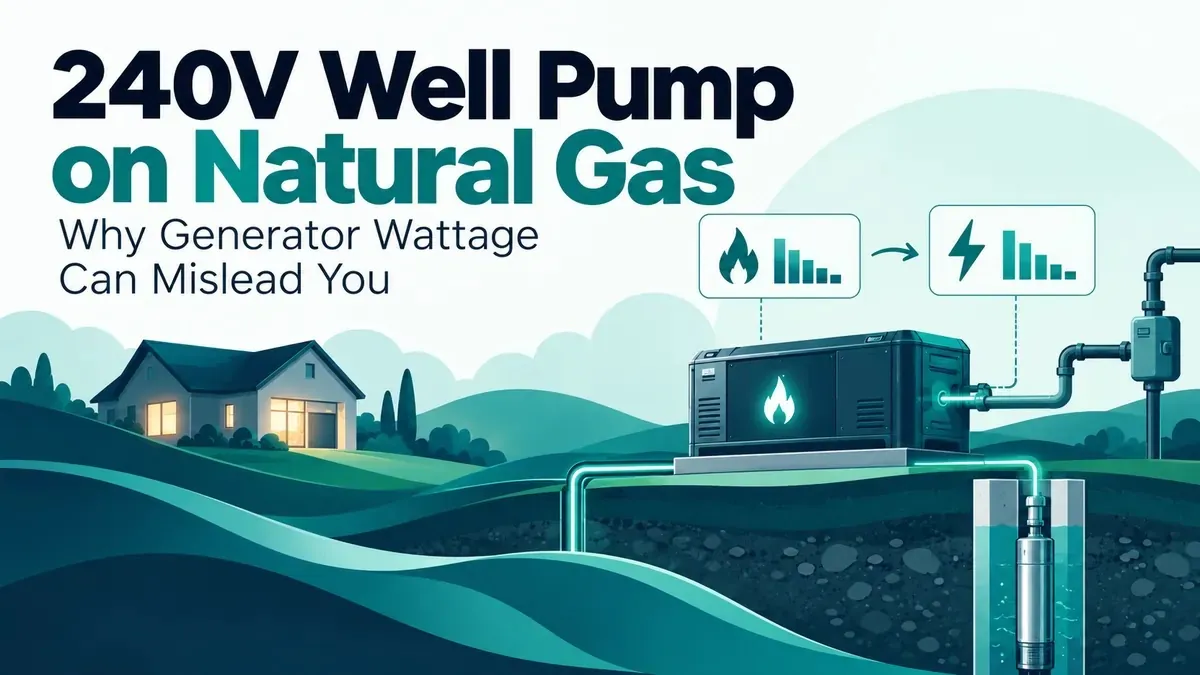
Buy the natural-gas number. Ignore the biggest number on the box.
Best all-round shortlist: Westinghouse WGen11500TFc, delivering 9,500W continuously on natural gas. More power: DuroMax XP15000HXT at 10,260W, useful when larger simultaneous loads justify its weight and fuel demands. Inverter option: Westinghouse iGen12000TFc at 7,200W, better suited to a smaller essentials-only plan.
Before ordering: compare your pump’s starting current, the home’s natural-gas supply and the actual loads that might run together.
See the fuel-by-fuel comparison and source documents.
More output on natural gas
DuroMax XP15000HXT · 89/100. 10.26 kW NG continuous, 12.825 kW NG peak, substantial 240V headroom. Requires a capable gas feed and space for a 362 lb machine.
Check exact DuroMax on AmazonMost balanced starting point
Westinghouse WGen11500TFc · 90/100. 9.5 kW NG continuous, 12 kW NG peak, 230 lb and established model documentation.
Check exact Westinghouse on AmazonBuyer Checkpoint / Category Capability Index
89/100 vs 90/100 vs 86/100: what the scores actually reward
The Buyer Checkpoint Capability Score ranks each generator’s documented natural-gas output, 240V capability, power quality, practical design and product evidence. It is a category score: choose the model that fits your pump, household load and gas connection—not simply the highest number.
DuroMax XP15000HXT
Most rated natural-gas power and peak headroom of the three. Heavy and fuel-hungry at full load.
Westinghouse WGen11500TFc
Strong capacity/weight balance; frequent practical shortlist leader where 9.5kW NG is enough.
Westinghouse iGen12000TFc
Lower NG output, but inverter design, low published THD and a quieter published sound figure.
BUYER CHECKPOINT / FIVE-FACTOR TECHNICAL FIT · REASSESSED OCT 31, 2026
How each score is earned — no price penalty
These are editorial fit assessments for the stated buyer scenario, re-expressed from the documented capabilities discussed in this guide; not laboratory testing, a safety certificate, an Amazon star rating or proof that a specific installation works. Absolute purchase price, potential affiliate commission and arbitrary affordability thresholds earn zero positive or negative points.
Evidence limitation: The high scores describe conditional technical capabilities, not a new 2026 live review or an endorsement of current marketplace ratings. Each item must still pass the Amazon offer/ratings gate.
Purchase and installation expenses, consumables, servicing and alternatives are discussed separately. A technically strong product can still fail the commercial gate or a critical site requirement. Read our scoring methodology and evidence rules before treating a score as a buying decision.
Buy if: you need verified natural-gas continuous watts for a 240V well pump, a qualified installer has confirmed the gas line and meter can feed the generator under load, and you will size the transfer switch to the pump’s starting current. The WGen11500TFc (9,500W continuous on natural gas) is then the cleanest balanced choice for most homes.
Don’t buy if: you are still looking at the gasoline peak wattage, you have not measured the pump’s starting current, or the natural-gas supply has not been verified. Peak watts on the box do not equal continuous output on natural gas.
STRONGEST BALANCED NATURAL-GAS STARTING POINT
Westinghouse WGen11500TFc — 9,500W continuous on natural gas
Once the pump start and the gas line are confirmed, this is the listing to check first.
Check the exact WGen11500TFc on AmazonConfirm the exact model and seller before adding to cart.
Fit check
Three answers. The card on the right updates with the model that fits.
What continuous natural-gas output do you need?
Have you confirmed the gas line and meter capacity?
What is your primary constraint?
Step 01 / The number that changes the purchase
A 12,000W label can mean only 7,200W on natural gas
Manufacturers commonly lead with gasoline peak watts. For a household connected to natural gas, the relevant figures are natural-gas running watts and natural-gas peak watts. The fuel choice changes both. Compare the same fuel, at the same voltage, on the exact model.
| Exact model | Gasoline | Propane | Natural gas | NG running reduction vs gasoline |
|---|---|---|---|---|
| Westinghouse iGen12000TFc | 9,000 / 12,000 W | 8,100 / 11,000 W | 7,200 / 9,800 W | −20.0% |
| Westinghouse WGen11500TFc | 11,500 / 14,500 W | 10,500 / 13,500 W | 9,500 / 12,000 W | −17.4% |
| DuroMax XP15000HXT | 12,000 / 15,000 W | 11,400 / 14,250 W | 10,260 / 12,825 W | −14.5% |
The iGen illustrates the trap. Its 12,000W nameplate peak is the gasoline starting figure; its 7,200W natural-gas continuous rating is 40% below that headline peak. That does not make it a poor machine. It makes it the wrong purchase for a load plan that needs 9kW continuously on natural gas.
On the other hand, an oversized generator has actual costs: higher purchase cost, storage footprint, fuel demand and maintenance. We should buy measured headroom, not the highest number.
Step 02 / Pump compatibility
Will it actually start a 1 HP or 1.5 HP well pump?
Horsepower alone cannot answer that. The pump motor/controller may draw substantially more electrical current at startup than in steady operation. Some controllers use soft-start or variable-speed drives, others do not. A generator's advertised peak-watt figure is not a promise about a particular motor's inrush duration, power factor or behavior through a long extension run.
The 240V × 35A example people often misread
Suppose a pump's actual documented starting current is 35A at a nominal 240V. The starting apparent demand is 240 × 35 = 8,400 VA (8.4 kVA). This is not automatically 8,400 watts. Motors are inductive, and the active power, phase relationship, surge duration, voltage drop and generator response all matter. The calculation is an illustration, not a standard specification for a 1 HP pump.
That is why motor start matters more than a reassuring headline wattage. Voltage drop and overlapping compressor starts can defeat an otherwise adequate continuous-power rating.
Four details to obtain before clicking Buy
- Pump motor model and voltage: 120V or 240V, single phase, 60Hz, and the exact motor/control-box family.
- Running and starting current: nameplate full-load amps plus locked-rotor/starting characteristics or manufacturer start-generator guidance.
- Transfer wiring: hardwired pump circuit, interlock/transfer switch, bonded-neutral and GFCI compatibility, and conductor length.
- Concurrent starts: whether an A/C compressor, refrigerator, pressure-system motor or other load might start with the pump.
For the separate question of power-station backup versus a fuel generator, read our related 240V well-pump battery backup sizing guide. It covers battery energy and inverter motor-start limitations; this guide concentrates on natural-gas generator sizing.
Step 03 / Original buying calculation
Build a realistic simultaneous-load budget, not a shopping-list total
Size for your biggest realistic overlap: the circuits you will run together plus the motor that starts next. The example below shows how to build a load budget that is useful for comparing generator models.
| Load during outage | Illustrative running load | Why it matters |
|---|---|---|
| 240V well pump | 1,300W | Actual start-current requirement must be checked separately. |
| Refrigerator and freezer together | 450W | Compressor starts can overlap with pump starts. |
| Furnace blower / controls | 700W | Check whether heat source and blower need electricity. |
| Lights, internet and essentials | 350W | Small individual loads accumulate. |
| Contingency for remaining planned loads | 700W | Do not use this as a substitute for an inventory. |
| Illustrative continuous total | 3,500W | Continuous arithmetic only, not a motor-start recommendation. |
For example, with 3,500W of running loads, the remaining continuous natural-gas headroom is 3,700W on the iGen, 6,000W on the WGen and 6,760W on the DuroMax. That 3,060W gap between iGen and DuroMax can make more difference than the model name. Motor starting must still be checked separately.
Get the motor/controller starting-current figure before using these headroom numbers to make a purchase. It turns a vague shopping comparison into a decision about your actual well.
Step 04 / Purchase routes
Three exact Amazon models and the job each is best placed to do
Each link below opens the identified Amazon.com model directly. Compare the selected fuel configuration and current seller on the product page.
DuroMax XP15000HXT
Buyer Checkpoint 89/100. Published NG 10,260W running / 12,825W peak. Best on-paper power headroom here, but a 362 lb class machine with a substantial gas-feed requirement.
ASIN B0BDQRQCC2 · Historical buyer ratings around 4.5/5 from 2,000+ reviews. Official model specifications
See exact DuroMax Amazon listingWestinghouse WGen11500TFc
Buyer Checkpoint 90/100. Published NG 9,500W running / 12,000W peak. A credible first shortlist entry if your verified simultaneous loads and motor-start behavior fit its ratings.
ASIN B0CLH9RBYD · Historical buyer ratings around 4.8/5 from 1,000+ reviews. Official model specifications
See exact Westinghouse Amazon listingFuel reminder: 11,500W running on gasoline; 9,500W on natural gas.
Westinghouse iGen12000TFc
Buyer Checkpoint 86/100. Inverter design, ≤3% manufacturer-published THD, 64 dBA published low-end sound figure. The quieter, more electronics-oriented candidate—but the smallest NG headroom in this selection.
ASIN B0F9LHST5Z · Historical buyer ratings around 4.7–4.8/5 from roughly 60–70 reviews. Official model specifications
See exact iGen Amazon listingCompare the exact iGen12000TFc tri-fuel version; similar iGen names have different specifications.
Why one recommendation can score lower: if you need to back up only the pump, heat blower and a few small loads, an 86/100 lower-capacity inverter can be the better personal purchase than a 89/100 generator that is much larger than necessary. Capability is not buyer fit.
Step 05 / Hidden constraint
Natural gas is convenient only if your house can actually feed the generator
Natural-gas operation avoids continually refilling a gasoline tank, but being connected to a utility gas meter does not prove your branch line can deliver the required flow and pressure. Meter capacity, regulator pressure, simultaneous furnace/water-heater draw, pipe diameter, run length, connectors, pressure drop and local installation rules all matter.
DuroMax specifies 278,000 BTU/hour at full load and natural-gas inlet pressure of 6–9 inches water column for the XP15000HXT. Have the gas line and meter sized for that load alongside your other appliances.
Ask the installer for these answers
- What is the available natural-gas flow at the connection while other gas appliances operate?
- What generator inlet pressure is required under load, and will the proposed regulator and line maintain it?
- Where will the generator sit while remaining safely outdoors and accessible in bad weather?
- Does the property have a code-compliant generator connection with the correct neutral/bonding arrangement?
Step 06 / Outages measured in days
A 72-hour blackout changes the decision more than peak wattage does
If your goal is running water through three days without utility power, separate three questions: can the motor start; can you sustain essentials; and can you provide fuel and operate the machine safely for the intended duration? A gasoline runtime claim at 25% or 50% load is not a 72-hour fuel guarantee.
| Generator | Gasoline tank | Published gasoline runtime at 50% load | What 72h implies |
|---|---|---|---|
| iGen12000TFc | 7.9 gal | 11 hours | About 6.5 rated 50%-load tank-equivalents. |
| WGen11500TFc | 9.5 gal | 9.5 hours | About 7.6 rated 50%-load tank-equivalents. |
| DuroMax XP15000HXT | 13.2 gal | 12 hours | About 6 rated 50%-load tank-equivalents. |
The runtime figures below show how quickly liquid-fuel planning changes with load. A 50% load on one generator is not the same wattage as 50% on another; use each model’s fuel and load figures when planning multi-day outages.
Natural gas removes much of the refueling work while the local gas network remains available. In regions where storms can disrupt both services, consider whether propane storage is worth adding to the backup plan.
Step 07 / Full installed cost
The generator purchase price is not the backup-system price
Choosing the cheapest model on Amazon can be a costly mistake if the required 240V home connection and natural-gas supply were ignored. Conversely, paying much more for additional watts may do nothing if a smaller model already satisfies the exact circuit and starting plan.
| Cost category | Questions that change your budget |
|---|---|
| Generator + delivery | Exact ASIN, seller warranty, local stock, weight, freight/unloading and return terms. |
| Electrical work | Panel and inlet, transfer switch or approved interlock, breaker and cable ratings, bond/neutral configuration. |
| Gas connection | Gas contractor, meter capacity, permitted pipe run, inlet pressure and shutoff arrangement. |
| Placement and weather protection | Outdoor location, safe distance, compliant shelter (if applicable), security and storage. |
| Operating costs | Fuel/gas supply, oil changes, scheduled exercises, engine maintenance, battery/starting system. |
| Backup reliability | Failure-mode planning, circuit prioritization, maintenance access and owner readiness. |
One useful buying question before you pay
Ask your contractor: “If I spend the extra money on this larger tri-fuel generator, which of my measured starting or simultaneous-load constraints does it solve?” If there is no clear constraint, you may be buying unused capacity instead of water-backup reliability.
Questions that rarely get answered on a product listing
The well-pump and natural-gas buying FAQ
Can a 12,000-watt generator run my 240V well pump on natural gas?
The answer depends on the natural-gas rating and your motor’s starting demand. For the iGen12000TFc, 12,000W is the gasoline peak figure, while natural-gas running power is 7,200W. Use the smaller number for a continuous-load budget.
Does a 50-amp 240V outlet mean 12,000W available continuously?
No. A 50A receptacle has a physical rating, but the generator's actual continuous output depends on its engine, fuel and protective limits; cables, transfer devices and breakers add limits too. For the iGen on natural gas, the maker explicitly rates 7,200W continuous, equivalent to 30A at 240V in a simplified balanced-load calculation.
Can I start the air conditioner and well pump at the same time?
Two motor startups can overlap and pull voltage down. A load-sequencing plan or a suitable manufacturer-approved soft-start system can make the difference; have the motor and circuit details checked.
Is an inverter generator automatically better for a well pump?
No. Inverter models can provide cleaner published electrical output and may have lower noise, but that alone does not guarantee motor starting. Compare the specific 240V outlet, natural-gas ratings and exact motor/controller requirements first.
Will natural gas keep flowing in every blackout?
Often, yes—but the local gas system, meter and pressure must continue operating. If extended outage resilience is the goal, assess how the property will perform without either utility.
What if the DuroMax listing has no acceptable Amazon seller?
Use the WGen11500TFc as the next model to compare if its 9,500W natural-gas rating covers your loads. For a smaller, quieter setup, consider the iGen12000TFc. Match exact SKU and seller before paying.
The decision: buy enough verified natural-gas headroom, not maximum advertised watts
First confirm the pump and gas supply. If your verified NG load budget fits 9.5kW, start by evaluating the WGen11500TFc. If you genuinely need more than that and can supply the fuel safely, compare the DuroMax XP15000HXT. If your loads fit 7.2kW and lower published noise matters, review the iGen12000TFc.
Review the WGen11500TFc on AmazonSee the exact product page for the current offer and seller.
Sources and research notes
Research note: Manufacturer model sheets and identifiable U.S. listings reviewed October 30, 2026. Fuel-by-fuel output and the load calculations are document-based; this is not a hands-on pump or generator test.
- Westinghouse iGen12000TFc official specification and fuel output.
- Westinghouse WGen11500TFc official specification and fuel output.
- DuroMax XP15000HXT official specification, NG flow and pressure requirements.
- U.S. CPSC: 2026 generator / carbon-monoxide safety guidance.
- DuroMax XP15000HXT Amazon.com identifier: B0BDQRQCC2.
- Westinghouse WGen11500TFc Amazon.com identifier: B0CLH9RBYD.
- Westinghouse iGen12000TFc Amazon.com identifier: B0F9LHST5Z.
Buyer Checkpoint is an independent research publication. Product links currently point to individual Amazon listings without affiliate tracking. Generator safety: Never backfeed a wall outlet; generators must operate outdoors, well away from buildings and openings. Use qualified professionals for electrical transfer equipment and natural-gas hookups.
Affiliate disclosure: This article contains paid Amazon links. As an Amazon Associate I earn from qualifying purchases.